2020
| 64. | C. Mutalik, Y.-C. Hsiao, Y.-H. Chang, D. I. Krisnawati, M. Alimansur, A. Jazidie, M. Nuh, C.-C. Chang, Di-Yan Wang,* and T.-R. Kuo* 2020: High UV-Vis-NIR Light-Induced Antibacterial Activity by Heterostructured TiO2-FeS2 Nanocomposites, Int. J. Nanomed., 2020, 15, 8911–8920. |
| 63. | S.-K. Huang, Y.-C. Wang, W.-C. Ke, Y.-T. Kao, N.-Z. She, J.-X. Li, C. W. Luo,* A. Yabushita, Di-Yan Wang, Y. J. Chang, K. Tsukagoshi,* and Chun-Wei Chen* 2020: Unravelling the Origin of Photocarrier Dynamics of Fullerene-Derivative Passivation of SnO2 Electron Transporters in Perovskite Solar Cells, J. Mater. Chem A, 2020, 8(44), 23607–23616. |
| 62. | S. B. Patil, H.-J. Liao, and Di-Yan Wang* 2020: Challenges and Prospects of Polyatomic Ions Intercalation in the Graphite Layer for Energy Storage Applications, Phys. Chem. Chem. Phys., 2020, 22(43), 24842-24855. (Invited Review Article) |
| 61. | S. B. Patil and Di-Yan Wang* 2020: Exploration and Investigation of Periodic Elements for Electrocatalytic Nitrogen Reduction, Small, 2020, 2002885(44pp). (Review Article) |
| 60. | Y.-C. Wang, S.-K. Huang, T. Nakamura, Y.-T. Kao, C.-H. Chiang, Di-Yan Wang, Y. J. Chang, N. Koshida, T. Shimada, S. Liu, C.-W. Chen, and K. Tsukagoshi* 2020: Quantum-Assisted Photoelectric Gain Effects in Perovskite Solar Cells, NPG Asia Materials, 2020, 12, 54(10pp). |
| 59. | C.-Y. Wei, P.-C. Lee, C.-W. Tsao, L.-H. Lee, Di-Yan Wang, and C.-Y. Wen* 2020: In-situ Scanning Electron Microscopy Observation of MoS2 Nanosheets during Lithiation in Lithium Ion Batteries, ACS Appl. Energy Mater., 2020, 3(7), 7066-7072. |
| 58. | Y.-T. Kao, Shivaraj B. Patil, C.-Y. An, S.-K. Huang, J.-C. Lin, T.-S. Lee, Y.-C. Lee, H.-L. Chou, C.-W. Chen, Y. J. Chang, Y.-H. Lai, and Di-Yan Wang* 2020: A Quinone-Based Electrode for High Performance Rechargeable Aluminum Ion Batteries with Low-cost AlCl3-urea Ionic Liquid Electrolyte, ACS Appl. Mater. Interfaces, 2020, 12(23), 25853-25860. |
| 57. | C. Mutalik, Di-Yan Wang, D. I. Krisnawati, A. Jazidie, S. Yougbare, and T.-R. Kuo* 2020: Light-Activated Heterostructured Nanomaterials for Antibacterial Applications, Nanomaterials, 2020, 10(4), 643(16pp). (Review Article) |
| 56. | T.-S. Lee, S. B. Patil, Y.-T. Kao, J.-Y. An, Y.-C. Lee, Y.-H. Lai, C.-K. Chang, Y.-S. Cheng, Y.-C. Chuang, H.-S. Sheu, C.-H. Wu, C.-C. Yang, R.-H. Cheng, C.-Y. Lee, P.-Y. Peng, L.-H. Lai, H.-H. Lee, and Di-Yan Wang* 2020: Real-Time Observation of Anion Reaction in High Performance Al Ion Batteries, ACS Appl. Mater. Interfaces, 2020, 12(2), 2572-2580. |
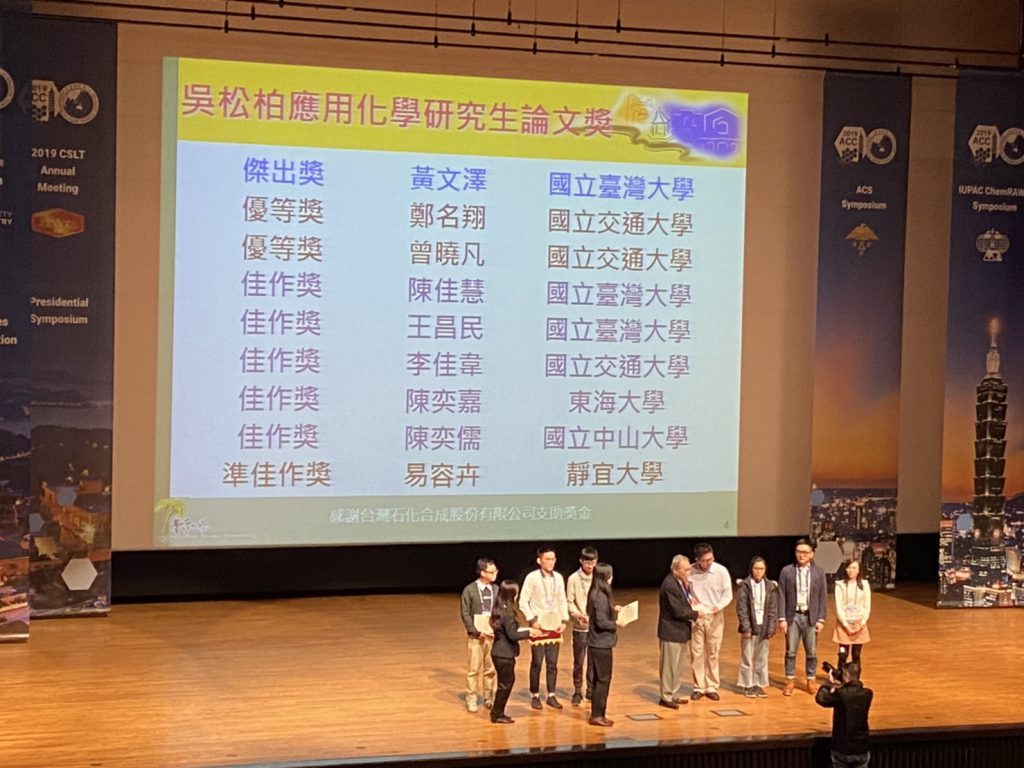
08 Dec. 2019, Congratulations “Yi-Chia receive an research thesis award in 2019化學年會”
Dec. 8 2019, Congratulations “Yi-Chia receive an research thesis award in 2019 化學年會”
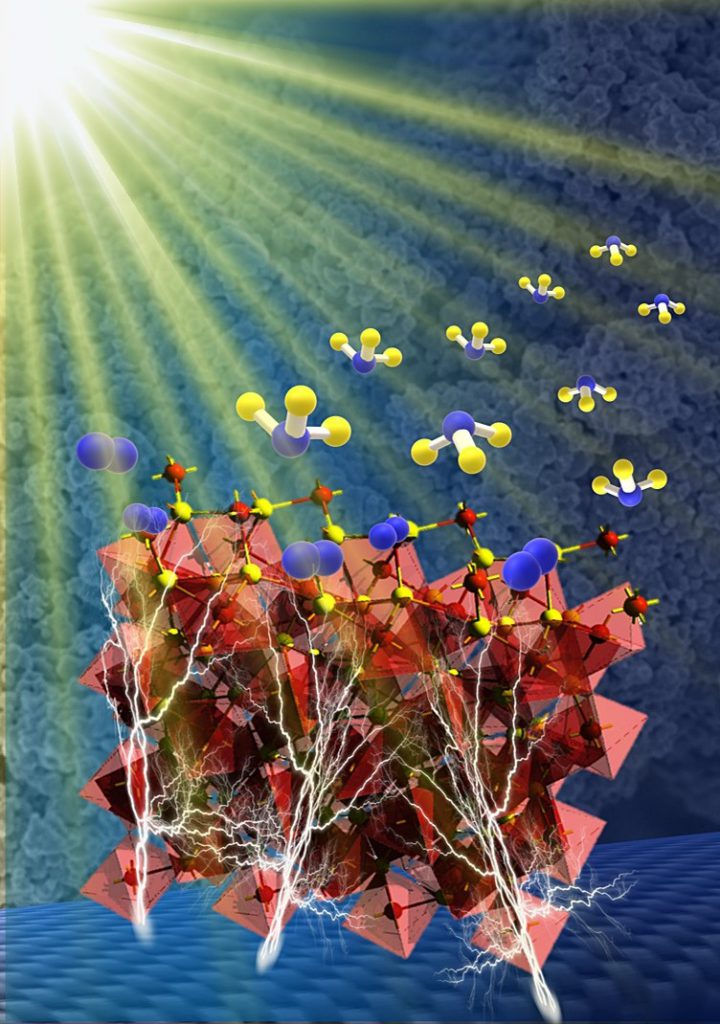
14 Oct 2019, Our work “Photoactive Earth-Abundant Iron Pyrite Catalysts for Electrocatalytic Nitrogen Reduction Reaction” has been published on Small
Photoactive Earth-Abundant Iron Pyrite Catalysts for Electrocatalytic Nitrogen Reduction Reaction
Chia-Che Chang, Shin-Ren Li, Hung-Lung Chou,* Yi-Cheng Lee, Shivaraj Patil, Ying-Sheng Lin, Chun-Chih Chang, Yuan Jay Chang and Di-Yan Wang*
https://doi.org/10.1021/acsami.0c04640
The generation of ammonia, hydrogen production and nitrogen purification are considered as energy intensive processes accompanied with large amount of CO2 emission. The electrochemical method assisted by photo energy has been widely utilized for the chemical energy conversion. In this work, the earth-abundant iron pyrite (FeS2) nanocrystals grown on carbon fiber paper (FeS2/CFP) was found to be an electrochemical and photoactive catalysts for nitrogen reduction reaction (NRR) under ambient temperature and pressure. The electrochemical results revealed that FeS2/CFP achieved a high Faradaic efficiency (FE) ~14.14% and NH3 yield rate~ 0.096 mg/min at −0.6 V versus RHE electrode in 0.25 M LiClO4. During proceeding electrochemical catalytic reaction, the crystal structure of FeS2/CFP remained cubic pyrite phase analyzed by in-situ XRD measurement. Also, With near infrared laser irradiation (808 nm), NH3 yield rate of FeS2/CFP catalyst can be slightly improved to (0.1 mg/min) with high FE of 14.57%. Furthermore, density functional theoretical (DFT) calculations demonstrated that N2 molecule had strong chemical adsorption energy on the iron atom of FeS2. Overall, the iron pyrite-based materials have proven to be a potential electrocatalyst with photoactive behavior for ammonia production in practical applications.