

14 Apr. 2026, Our work “Hydration Shell Modulation of Al3+ for Efficient Aluminum Electrodeposition and Suppressed Hydrogen Evolution in Aqueous Batteries” has been accepted by ACS Applied Materials & Interfaces
Hydration Shell Modulation of Al3+ for Efficient Aluminum Electrodeposition and Suppressed Hydrogen Evolution in Aqueous Batteries
Jhen-Hao Huang,# Meng-Chi Hsieh,# Swathi M. Gowdru,# Chia-Che Chang,# Chen Chen,# Shu-Yao Huang, Yung-Yi Huang, Zhi-Jie Li, Yu-Cheng Wu, Han-Hsuan Hsieh, Yi-Chia Chen, Chun-Chih Chang*, Ying-Huang Lai, Chun-Jern Pan, and Di-Yan Wang*
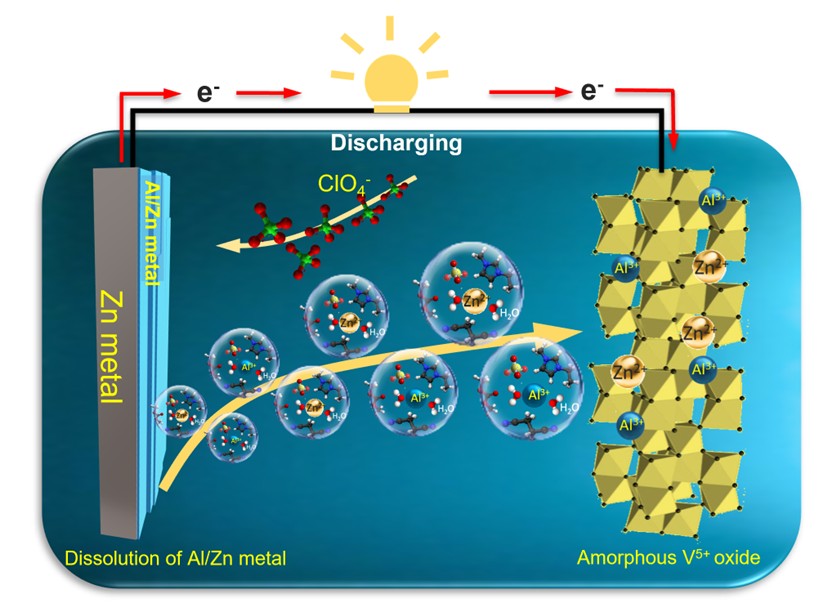
Reducing free water in aqueous electrolytes is crucial for suppressing hydrogen evolution reaction (HER) and improving the electrochemical performance of aluminum plating. In this study, an electrolyte system (Al(ClO4)3-DWES) was designed by introducing organic molecules dimethyl carbonate, 1-ethyl-3-methylimidazolium cation, and succinonitrile to modulate hydration shell and eliminate free water. Raman spectroscopy and molecular dynamics (MD) simulations confirmed the HER suppression through enhanced hydration bonding during Al plating. The galvanostatic cycling scan demonstrated the superior performance of Al(ClO4)3-DWES in enabling uniform Al deposition and improving plating/stripping efficiency on zinc foil. The detailed characterizations validated that the smooth and dense Al metal was actually plated with Zn metal, because Zn ions was found to be dissolved into electrolyte at the beginning cycles. Moreover, Al(ClO4)3-DWES electrolyte was successfully employed in aqueous Al-Zn/amorphous vanadium(V) oxide batteries, exhibiting high discharging capacity (250 mAh/g), excellent rate capability and superior cycling stability over 750 cycles with 99% Columbic efficiency. X-ray photoemission spectra revealed the roles of Al3+ and Zn2+ ions in the reversible intercalation/deintercalation process in the cathodic materials. Overall results confirm that hydration shell modulation of Al³⁺ with eliminating free water in the electrolyte enhances Al plating and enables stable Al-ion battery operation, paving the way for advanced aqueous battery technologies.
10 Apr. 2026, Our work “Cu Atom-doped CsPbBr3 Nanocrystals for Enhanced Photocatalytic CO2 Reduction Reaction” has been accepted by J. Phys. Chem. Lett.
Cu Atom-doped CsPbBr3 Nanocrystals for Enhanced Photocatalytic CO2 Reduction Reaction
Kuan-Chang Wu, Yu-Dian Chen, Yi-Chia Chen, Srimanta Das, Ishika Bhullar, Chia-Che Chang, Ying-Huang Lai, Soumitra Satapathi, Di-Yan Wang*
Photocatalytic CO₂ reduction (CO₂RR) is particularly attractive due to its ability to directly harvest solar energy, representing a promising and sustainable route toward carbon neutrality. All-inorganic halide perovskite nanocrystals, such as CsPbBr3, have emerged as highly promising photocatalysts owing to their exceptional electronic and optical properties. In this work, Cu atom-doped CsPbBr3 perovskite nanocrystals (Cu-CsPbBr₃ PNCs) were successfully developed and the role of Cu single-atom in CsPbBr3 PNCs for modulating their photocatalytic CO2RR was elucidated. Comprehensive structural characterizations, including X-ray diffraction (XRD), high-angle annular dark-field scanning transmission electron microscopy (HAADF-STEM), and X-ray absorption spectroscopy (XAS), collectively confirm that Cu element atomically distributed as single-atoms uniformly within the nanocrystal lattice, rather than undergoing phase segregation into clusters or long-range ordered Cu phases. A slight red-shift of the Cu K-edge XANES under illumination was found, indicating that a partial reduction of Cu²⁺ in Cu-CsPbBr₃ PNCs. The results represented that the occurrence of photoexcited electron transfer from CsPbBr₃ to the doped Cu sites during CO₂RR. Moreover, photocatalytic CO₂RR revealed that an optimal Cu-doping concentration in Cu-CsPbBr₃ PNCs achieves a significantly enhanced CO production rate of 2.80 μmol g⁻¹ h⁻¹, outperforming pristine CsPbBr3 (1.47 μmol g⁻¹ h⁻¹). Time-resolved photoluminescence (TRPL) measurements show a substantial decrease in carrier lifetime from 3.17 ns (pristine CsPbBr₃ PNCs) to 0.72 ns (optimal Cu-CsPbBr₃ PNCs), evidencing efficient electron trapping by Cu single atoms. Transient absorption (TA) spectra further reveal modified hot-carrier dynamics and pronounced carrier-trapping behavior. Overall, the enhanced photocatalytic activity of Cu-CsPbBr₃ PNCs toward CO₂ reduction is attributed to efficient nonradiative charge transfer from photoexcited CsPbBr₃ PNCs to the dopant Cu atoms. This design strategy opens a general avenue for the development of metal-atom-doped perovskite-based photocatalysts with improved efficiency for the CO₂ reduction reaction.
09 Apr. 2026, Our work “Modulation of Protons and Cations at the electrode-electrolyte interface for Effective Selectivity of Ammonia Production during Electrochemical Nitrate Reduction Reaction” has been accepted by Appl. Catal. B-Environ.”
Modulation of Protons and Cations at the electrode-electrolyte interface for Effective Selectivity of Ammonia Production during Electrochemical Nitrate Reduction Reaction
Jou-Chun Lin, Meng-Chi Hsieh, Lo-Yu Lee, Yi-Cheng Su, Yi-Chia Chen, Yung-Yi Huang, Cheng-Chi Xiao, Chueh-Cheng Yang, Chun-Chih Chang*, Chia-Hsin Wang* and Di-Yan Wang*
This study systematically investigates the competitive interactions between sodium ions (Na+) and protons (H+) and their specific influence on the electrochemical nitrate reduction reaction (NO3RR). Copper nanodendrites (Cu NDs) served as the catalysts, evaluated via chronoamperometry within NaNO3, HNO3, and equimolar mixed electrolytes at 0.1 M and 0.01 M concentrations. To elucidate complex interfacial processes, in-situ near-ambient pressure X-ray photoelectron spectroscopy (NAP-XPS) and molecular dynamics (MD) simulations were conducted. Findings reveal that in pure NaNO3, competitive adsorption of Na+ on the catalyst surface effectively suppresses NO3– binding, increasing overpotential and favoring nitrite (NO2–) formation between +0.2 V and -0.2 V (vs. RHE). Conversely, the presence of H+ promotes NO3– adsorption and significantly enhances ammonia production. These results clarify the origin of high overpotentials in neutral media and highlight how alkali cations and protons govern NO3RR selectivity. This work offers fundamental insights for designing efficient, sustainable, and electrocatalytic ammonia synthesis systems.
2026
| 97 | Tsung-Hsin Liu, Nutthun Thanajantaporn, Yung-Hung Huang, Jou-Chun Lin, Lo-Yu Lee, Cheng-Yu Yu, Ya-Wen Tang, Ya-Lun Ho, Jessie Shiue, Di-Yan Wang*, and Chun-Wei Chen* 2026: High-Performance, Bias-Free Solar Valorization of Nitrate and Iodide to Ammonia and Triiodide in Acidic Media, Appl. Catal. B-Environ., 2026, 399, 127131. |
| 96 | Jhen-Hao Huang,# Meng-Chi Hsieh,# Swathi M. Gowdru,# Chia-Che Chang,# Chen Chen,# Shu-Yao Huang, Yung-Yi Huang, Zhi-Jie Li, Yu-Cheng Wu, Han-Hsuan Hsieh, Yi-Chia Chen, Chun-Chih Chang,* Ying-Huang Lai, Chun-Jern Pan, and Di-Yan Wang,* 2026: Hydration Shell Modulation of Al3+ for Efficient Aluminum Electrodeposition and Suppressed Hydrogen Evolution in Aqueous Batteries, ACS Applied Materials & Interfaces, 2026, 18, 24444−24455. |
| 95 | Kuan-Chang Wu, Yu-Dian Chen, Yi-Chia Chen, Srimanta Das, Ishika Bhullar, Chia-Che Chang, Ying-Huang Lai, Soumitra Satapathi, and Di-Yan Wang,* 2026: Cu Atom-doped CsPbBr3 Nanocrystals for Enhanced Photocatalytic CO2 Reduction Reaction, J. Phys. Chem. Lett., 2026, 17, 5122−5129. |
| 94 | Jou-Chun Lin, Meng-Chi, Hsieh, Lo-Yu Lee, Yi-Cheng Su, Yi-Chia Chen, Yung-Yi Huang, Cheng-Chi Xiao, Chueh-Cheng Yang, Chun-Chih Chang,* Chia-Hsin Wang,* and Di-Yan Wang,* 2026: Modulation of Protons and Cations at the electrode-electrolyte interface for Effective Selectivity of Ammonia Production during Electrochemical Nitrate Reduction Reaction, Appl. Catal. B-Environ., 2026, 394, 126786 |
| 93 | Srimanta Das, Guguloth Venkanna, Ishika Bhullar, Manjunatha Kempasiddaiah, Saurabh Saini, Naveen Kumar Tailor, Mohammad Adil Afroz, Chia-Che Chang, Chih-Wen Pao, Di-Yan Wang, Komal Tripathi, Kamal Kishore Pant, and Soumitra Satapathi,* 2026: Exploring the synergistic effect of nickel and cobalt codoping in BiVO4: Impact on PEC hydrogen generation via water splitting, International Journal of Hydrogen Energy, 2026, 213, 153722. |
| 92 | Yung-Hung Huang,# Po-Hsien Wu,# Yang-Sheng Lu,# Yin-Cheng Lin, Chih-Ying Huang, Cheng-Yu Yu, Zih-Wei Cyue, Jou-Chun Lin, Chun-Chih Chang, Shao-Sian Li,* Bing Joe Hwang, Chun-Wei Chen,* and Di-Yan Wang,* 2026: Dual-Functional Atomic Layer Graphene Enable Bias-Free Photoelectrochemical Iodide Oxidation Reaction for Seawater Splitting, Carbon, 2026, 249, 121250. |
13 Jan. 2026, Dr. Yi-Chia Chen et al. received 2025 Best Article Award in “Chemistry ” of the Chemical Society Located in Taipei
【2025《化學》年度最佳論文獎】
得獎代表:王迪彥(國立臺灣師範大學化學系)
論文作者:陳奕嘉、吳冠璋、王迪彥*
論文名稱:鈣鈦礦奈米材料之動態結構成長機制的探討
論文出處:《化學》,第八十三卷,第二期,153–164 頁
論文連結:https://doi.org/10.6623/chem.202506_83(2).001
【2025 Best Article Award in “Chemistry ” of the Chemical Society Located in Taipei】
Award Recipient: Di-Yan Wang (Department of Chemistry, National Taiwan Normal University)
Authors: Yi-Chia Chen, Kuan-Chang Wu, Di-Yan Wang*
Article Title: Investigation of the Dynamic Structural Growth Mechanism of Perovskite Nanomaterials
Source: CHEMISTRY (Chemical Society Located in Taipei) Vol. 83, No. 2, pp. 153-164
Link: https://doi.org/10.6623/chem.202506_83(2).001
09 Jan. 2026, our work “Dual-Functional Atomic Layer Graphene Enable Bias-Free Photoelectrochemical Iodide Oxidation Reaction for Seawater Splitting” has been accepted by Carbon
Dual-Functional Atomic Layer Graphene Enable Bias-Free Photoelectrochemical Iodide Oxidation Reaction for Seawater Splitting
Yung-Hung Huang# , Po-Hsien Wu# , Yang-Sheng Lu# , Yin-Cheng Lin, Chih-Ying Huang, Cheng-Yu Yu, Zih-Wei Cyue, Jou-Chun Lin, Chun-Chih Chang, Shao-Sian Li*, Bing Joe Hwang, Chun-Wei Chen*, Di-Yan Wang*
https://doi.org/10.1016/j.carbon.2026.121250
Bias-free photoelectrochemical (PEC) seawater splitting has emerged as an attractive technology for solar-to-hydrogen (STH) conversion. This work demonstrates a promising alternative by replacing the sluggish kinetics of the oxygen evolution reaction (OER) with iodide oxidation reaction (IOR), which requires a much lower oxidation potential of 0.53 V vs. RHE. This approach facilitates bias-free solar-to-hydrogen (STH) conversion directly from natural seawater while simultaneously producing high-value triiodide (I3–) chemicals. An atomic layer of graphene functions as an efficient catalyst for PEC IOR when integrated with a Si heterojunction photoanode, exhibiting a promising PEC IOR with a low onset potential of 0.05 V vs. RHE. The unique two-dimensional energy dispersion and delocalized π-electrons of graphene facilitate rapid charge transfer, thereby enhancing overall catalytic efficiency. In-situ Raman spectroscopic analysis was performed to manifest that In-situ Raman spectroscopy reveals that adsorbed iodide/iodine species will induce local lattice strain in graphene, which perturbs the coherence of phonon scattering in the π-system. Moreover, when coupled with a Pt/graphene/Si heterojunction photocathode for HER, a bias-free PEC system for STH and IOR can be simultaneously achieved. This system demonstrates remarkable performance and stability, yielding a high photocurrent density of 14.22 mA/cm2 for simulated seawater and 13.13 mA/cm2 for natural seawater without any applied bias under 1 sun illumination. The integrated graphene/Si heterojunction photoelectrodes provide a promising platform for developing stable and high-performance bias-free PEC cells, facilitating simultaneous STH conversion and producing valuable chemicals from.
