31 Jan. 2022, Prof. Wang received 2021 CSLT, Outstanding Young Chemical Researcher Award
31 Jan. 2022, Prof. Wang received 2021 CSLT, Outstanding Young Chemical Researcher Award
https://chemistry.org.tw/news-single.php?mTitle=department&temp_id=724
李昌儒
李昌儒 Chang-Ru Lee
foreverlive0740@gmail.com
2022 MS Tunghai University
Current Job: TSMC
05 Nov. 2021, Prof. Wang received Academia Sinica Early-Career Investigator Research Achievement Award in 2021
簡評:
得獎人王迪彥博士的研究著重於以地球豐富元素發展奈米結構觸媒,針對無碳排放之電催化(EC)氮還原反應(NRR),建立臨場電化學搭配光譜分析技術,結合實驗與理論深入探討NRR 機制。國際上於EC-NRR 相關研究起始於2018 年,由於其環保性質、可於大氣環境下反應、使用水性電解質及低成本催化劑等優點而於近年來備受關注。王博士針對氮氣分子在催化劑表面上之低吸附能力,以及材料結構表面對氮氣的不相容性與低穩定性所造成活性不佳之問題,提出有效的解決方法。
此外,其利用紅外光吸收了解二硫化鐵在EC-NRR 之機制及調控二硫化鉬層狀材料結構增加EC-NRR 效率均為獨創發現,具有相當的國際領先度。EC-NRR 研究不僅有其學術價值,也有實際應用性(例如氮肥產業)。王博士勇於挑戰嶄新領域,並能迅速將研究成果發表在材料化學應用於能源領域同行所認定之重要國際期刊,顯見其研究實力卓越。王博士並受Small 期刊的邀稿,發表評論文章一篇(Exploration and Investigation of Periodic Elements forElectrocatalytic Nitrogen Reduction),足證其已成為國際尚處於初始競爭階段領域之領先者,實可為年輕研究人員之表率。
16 Sep. 2021, our work “Enhanced Hydrogen Evolution Efficiency Achieved by Atomically Controlled Platinum Deposited on Gold Nanodendrites with High-Index Surfaces” has been accepted by J. Mater. Chem. A
Enhanced Hydrogen Evolution Efficiency Achieved by Atomically Controlled Platinum Deposited on Gold Nanodendrites with High-Index Surfaces
Ying-Huang Lai,1*Sin-Ren Li,1# Swathi M G,1#Hsiao-Tzu Chang,1# Yu-Bin Huang,1 Yen-Ken Li,1 Yu-Mei Chen,1 Shivaraj B. Patil,1Shu-Yi Chang,1 Po-Kai Chen,1 Chia-Che Chang,1 Yi-Chia Chen,1 Chih-Wen Pao,2 Jeng-Lung Chen,2 Chuan-Yu Wei,3 I-Kuan Lin,3 Hung-Lung Chou,4Chun-Jen Su,2U-Ser Jeng,2,5 Tsung-Rong Kuo,6 Cheng-Yen Wen,3,7,8 Di-Yan Wang1*
https://doi.org/10.1039/D1TA07066E
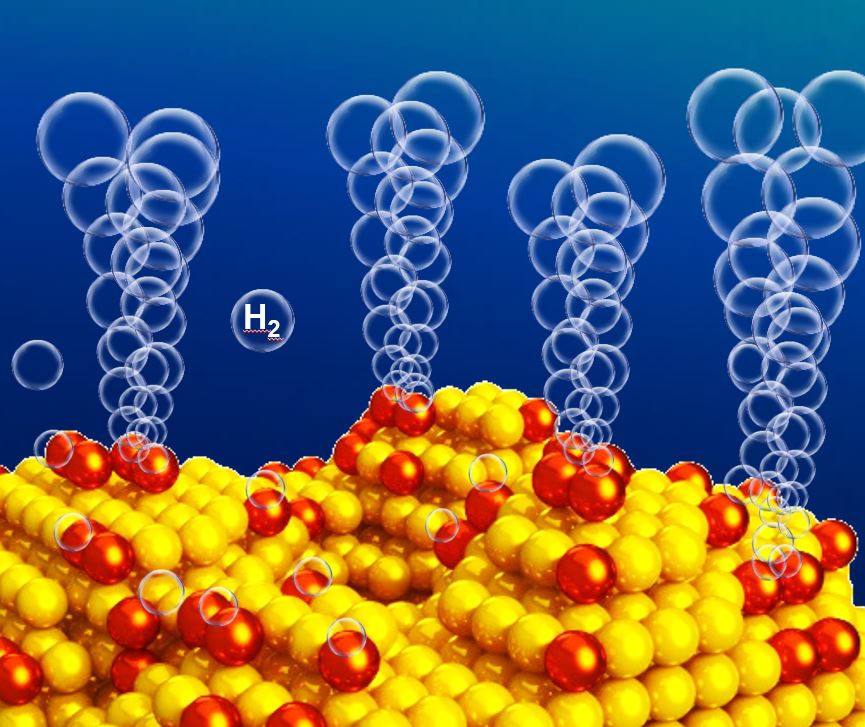
There have been lots of studies on hydrogen evolution reaction (HER) catalytic activity using ultralow loading of Pt catalysts or even Pt single atom catalysts as well. However, Pt single atom deposited on the surface of the carbon or metal oxide material showed some drawbacks, such as high possibility of Pt desorption from the supported material in the electrolyte. Besides, from the reaction mechanism perspective, each Pt atom in this type of catalyst was too far to achieve high HER efficiency via Tafel reaction pathway. In this work, gold nanodendrites (Au NDs) with high facet surface was chosen as the supported materials for studying the relation between the low loading amount of Pt atoms and reaction mechanism of HER activity. The atomic deposition of Pt atoms on the surface of Au NDs can be controlled effectively by using a constant-current synthetic method. It’s found that the HER electrocatalytic activity of ultralow Pt loading catalyst, Pt atoms to total surface atoms of Au NDs (O-Pt on Au NDs) was only 5.5%, could achieve high efficiency via Tafel reaction pathway, showing a low overpotential of ~18 mV at a current density of 10 mA cm−2 and a small Tafel slope of ~31 mV dec-1 which is close to that of commercial Pt/C with 20wt% Pt. Confirmed by Inductively Coupled Plasma Mass Spectrometry (ICP-MS), Pt loading amount of O-Pt on Au NDs was ~3.8 ± 0.2mg/cm2 on a physical area of carbon fibre paper. The turnover frequency (TOF) of O-Pt on Au NDs was achieved to be 40.1 ± 2.5H2 s−1 at 50 mV. This work provides a feasible approach to control atomic deposition of Pt element on the specific substrate as active catalysts for various catalytic applications.
June 2021, Shivaraj defends his PhD dissertation! Congratulations Shivaraj!
Congratulations,
Shivaraj on successfully defending his dissertation and becoming Dr. Shivaraj B. Patil!
Dr. Shivaraj B. Patil received his PhD’s degree from Tunghai University, Taiwan in 2021. In the three years of his PhD life, He focuses on electrocatalytic catalysis and energy storage systems. He has published five first-author papers on JMCA, Small, PCCP and ACS AMI, etc. The Di-Yan Lab wishes you the very best luck in your future.