



CO-tolerant ethylene glycol oxidation on p–d hybridized platinum ditelluride for seawater artificial leaves
Yung-Hung Huang, Tsung-Hsin Liu, Ya-Wen Tang, Meng-Chi Hsieh, Tzu-Chin Huang, Chih-Ying Huang, Shao-Ku Huang, Po-Hsien Wu, Fang-Yu Shen, Ya-Lun Ho, Chun-Chih Chang, Raman Sankar, Chun-Wei Chen*, Di-Yan Wang*
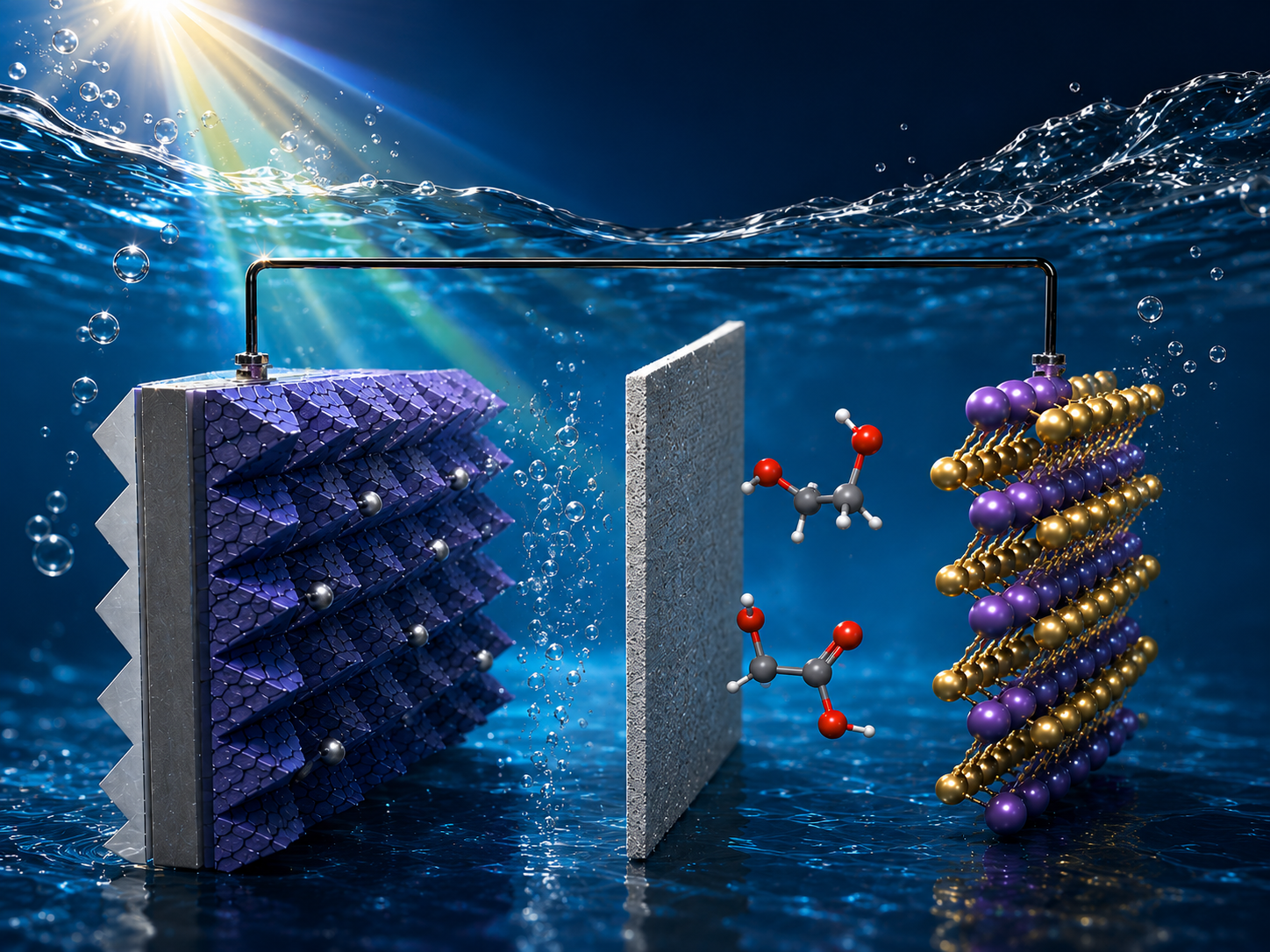
Seawater-based artificial leaves are fundamentally constrained by anodic surface poisoning and insufficient photovoltage for bias-free reaction under complex electrolytes. Here we report a pH-gradient photoelectrochemical–electrochemical (PEC–EC) system that couples photoelectrochemical hydrogen evolution reaction (HER) and electrochemical ethylene glycol oxidation reaction (EGOR) enabled by CO-tolerant 1T-PtTe2 in both fresh water and natural seawater. As an anodic electrocatalyst for EGOR, platinum ditelluride exhibits a low onset potential of 0.42 V vs. RHE, achieves highly selective production of the value-added product glycolate (GA) with a Faradaic efficiency of 96.4% at 0.9 V vs. RHE, and maintains high stability in natural seawater. Electronic structure analysis reveals that tellurium incorporation induces a downshift of the platinum d band center, weakening the adsorption of CO-derived intermediates and suppressing surface poisoning without compromising reactant activation. Our PEC–EC device delivers bias-free current densities of 37.85 mA cm-2 in fresh water and 37.18 mA cm-2 in natural seawater and sustains continuous hydrogen and glycolate production for 120 hours. The demonstration of this PEC–EC system provides a general framework for designing bias-free photoelectrochemical devices operating at appreciable current densities and advances the practical implementation of seawater-based artificial leaves.